

Linux is no longer just an operating system; it has become the quiet powerhouse driving today’s industrial transformation. From real-time control on the factory floor to edge AI running on compact embedded devices, and now with the growing influence of open-source initiatives like the Linux Foundation’s Margo project, Linux is redefining how manufacturers close the long-standing gap between IT and OT.
At ADISRA, we are seeing this shift firsthand. Several of our hardware partners are now delivering industrial devices preloaded with Linux, a clear signal of how rapidly the industry is standardizing on flexible, secure, and open platforms. What once felt like a gradual evolution has accelerated into a full-scale transition; one that is reshaping how modern industrial systems are designed, deployed, and connected.
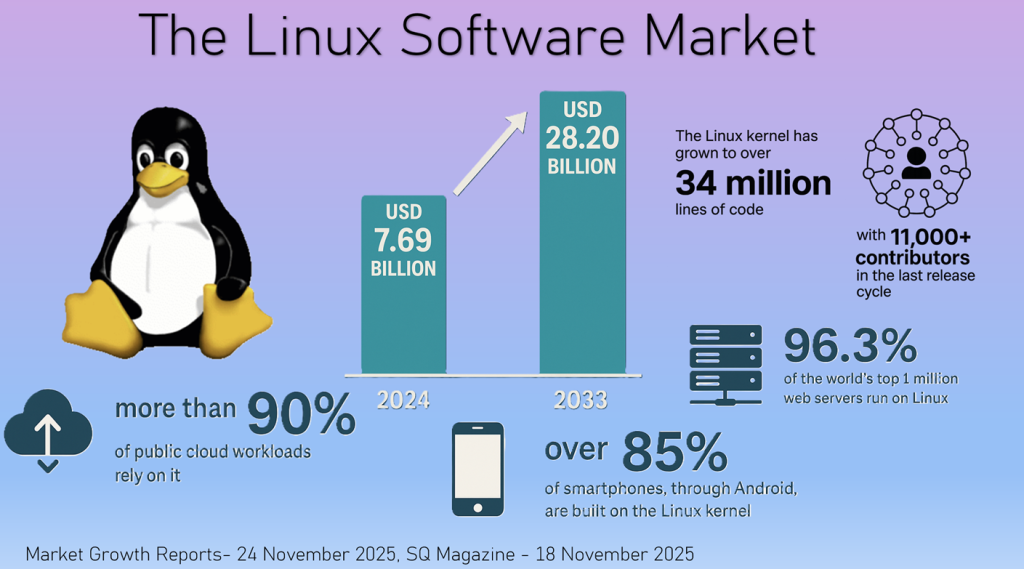
According to Market Growth Reports, the Linux Software Market, valued at USD 7.69 billion in 2024, is projected to reach USD 28.20 billion by 2033, reflecting a decisive global shift toward open, scalable, and cost-efficient systems. This momentum is no surprise: 96.3% of the world’s top 1 million web servers run on Linux, more than 90% of public cloud workloads rely on it, and over 85% of smartphones, through Android, are built on the Linux kernel. From massive data centers to the device in your hand to intelligent systems at the network edge, Linux has become truly ubiquitous.
Linux continues to gain momentum in industrial automation worldwide, propelled by its flexibility, reliability, and expanding use across embedded systems, IoT devices, and edge computing.
Although it can be challenging to extract exact global market-share figures for Linux specifically in industrial automation, given its overlap with the broader embedded systems market, the trend is unmistakable: adoption is accelerating, and Linux is becoming a cornerstone of next-generation industrial architectures.
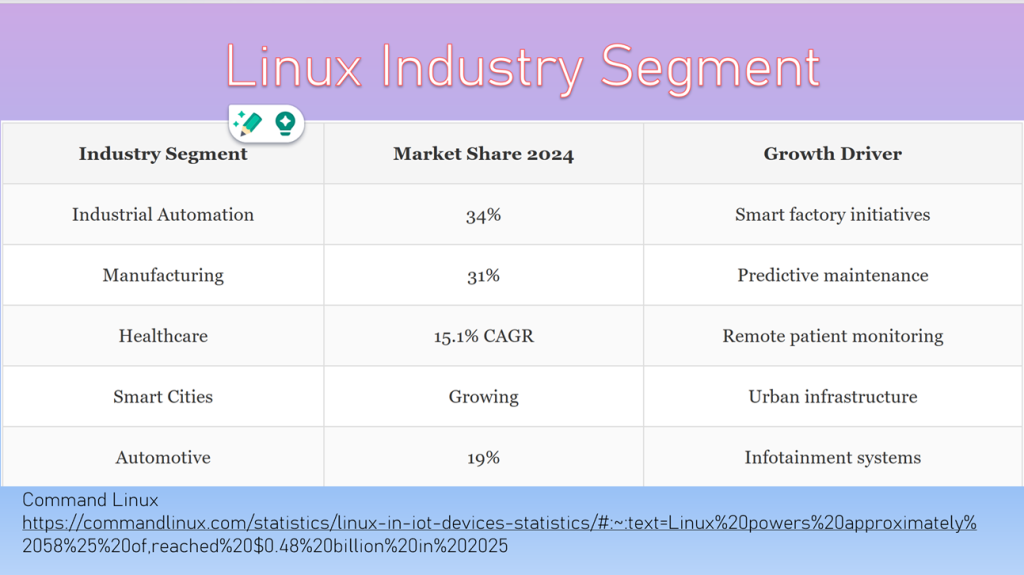
The Linux Surge: Trends Powering the Next Industrial Revolution
Several trends are helping to propel the Linux operating system in industrial automation. Some of these trends are:

– Embedded Systems
Embedded systems are specialized computing units designed to perform dedicated functions within larger devices. They play a vital role in industrial automation. They enable precise control, continuous monitoring, and real-time data acquisition, making them foundational to modern factory operations.
What makes embedded Linux so compelling is its adoption across a wide range of industries far beyond automation. This broad ecosystem fuels continuous innovation, improving performance, security, and flexibility, benefits that flow directly into industrial applications.
According to SQ Magazine, Linux statistics:
– 62.7% of IoT developers now build firmware and services on Linux-based embedded platforms.
– Linux powers 39.5% of all embedded systems, spanning sectors such as automotive, medical, and consumer electronics.
– Raspberry Pi OS, a Debian-based distribution, surpassed 10.2 million active devices in 2025, reinforcing Linux’s dominance in prototyping and commercial embedded solutions.
– In industrial automation, Linux-based PLCs account for 33.1% of new deployments this year.
– Automotive platforms like AGL and GENIVI are embedded in 32.4% of new vehicles worldwide.
– Linux-based smart home technologies, including hubs and thermostats, represent 44.6% of the U.S. market.
– And at the edge, Linux leads decisively, powering 71.9% of edge inference workloads for AI-driven devices.
Together, these trends demonstrate one clear truth: embedded Linux is not just growing; it is becoming the standard across industries, including industrial automation.

– IoT and Edge Growth
The rapid growth of IoT and edge computing is accelerating Linux adoption across industrial environments. IoT devices equipped with sensors and embedded software generate enormous volumes of operational data, while edge computing processes that information locally to enable real-time insight and immediate action. Together, these technologies are reshaping industrial automation into smarter, faster, and more autonomous systems. According to the U.S. National Institute of Standards and Technology, Linux now powers approximately 58% of the 14.2 billion connected IoT devices operating globally in 2024.
Linux is the platform of choice in this space. Its flexibility, security, and ability to scale from tiny sensors to robust gateways make it ideal for edge deployments. Developers can tailor lightweight Linux distributions to meet the strict resource constraints and reliability demands of industrial edge devices.
Market data underscores this momentum. The global edge computing market is expected to grow from USD 168.40 billion in 2025 to USD 249.06 billion by 2030, driven by advancements such as AI-enabled processing, 5G connectivity, and ruggedized edge infrastructure. Containerization is accelerating this shift: 78% of Kubernetes clusters run on Linux, and lightweight Linux-based distributions now support more than 14 billion connected IoT devices worldwide. By packaging applications together with all necessary libraries, dependencies, and configuration files into isolated units called “containers,” this approach ensures consistent, portable, and efficient deployment across diverse environments. In 2023, 60% of IoT edge nodes were deployed on Linux to meet real-time operational requirements.
Industrial sectors, such as manufacturing, utilities, logistics, and oil and gas, are leading this surge as they rely on edge computing for device management, robotics coordination, protocol bridging, and asset tracking. Processing data at the source enables instant alerts, automated shutdowns, load balancing, and predictive maintenance. Linux-powered edge nodes also support secure communication standards like OPC-UA and MQTT, enhancing interoperability across diverse systems.
As IoT adoption accelerates, Linux remains central to enabling efficient, resilient, and scalable edge architectures that drive digital transformation across the industrial ecosystem.

– Industrial Automation Adoption
Industrial automation, using control systems, robotics, and intelligent software to operate machinery with minimal human intervention, continues to expand across global industries. Companies are embracing automation to achieve greater efficiency, consistency, and scalability in their operations.
Several key drivers fuel this growth:
– Higher Efficiency & Productivity: Automated systems deliver faster production cycles and increased throughput.
– Improved Quality: Precision and repeatability ensure consistent, high-quality output.
– Lower Operational Costs: Though upfront investment can be significant, automation reduces labor costs, minimizes waste, and optimizes energy use.
– Enhanced Safety: Automation removes workers from hazardous or physically demanding tasks.
– Demand Scalability: Automated systems allow manufacturers to scale production rapidly as market needs grow.
Linux plays a significant role in this evolution. Its stability, flexibility, and open architecture make it a preferred platform for many industrial automation components, including:
– PLCs: Linux-based PLCs offer advanced functionality, connectivity, and customization.
– Industrial PCs: Linux is widely used for control, monitoring, HMI/SCADA, and data acquisition.
– Robotics Controllers: Modern robots increasingly rely on Linux for real-time control and coordination.
– Industrial Gateways & Routers: Linux powers the communication infrastructure that links devices, networks, and cloud systems.
As smart manufacturing accelerates and AI and machine learning become integral to industrial processes, Linux is positioned to gain even wider adoption, serving as the foundation for the next generation of intelligent, automated systems.
– Smart Manufacturing, AI/ML, and the Growing Role of Linux
Smart manufacturing, core to Industry 4.0, integrates AI, machine learning, IoT, and advanced analytics into production environments to create flexible, adaptive, and data-driven operations. Unlike traditional automation, which relies strictly on predefined instructions, AI and ML enable systems to learn from data, optimize processes autonomously, and make intelligent real-time decisions.
Linux is a foundational technology powering this shift. Its stability, openness, and scalability make it ideal for AI-enabled industrial environments:
– Edge Devices: Lightweight Linux distributions support on-device data preprocessing and AI inference.
– Industrial PCs & Servers: Linux provides a robust platform for running complex AI/ML models and analytics workloads.
– Robotics: Many advanced robots use Linux-based controllers to integrate real-time control with AI capabilities.
– Development Platforms: Linux is the primary environment for building and deploying industrial AI/ML applications.
– Open-Source Ecosystem: A vast library of Linux-compatible frameworks and tools accelerates innovation and lowers development barriers.
With manufacturers rapidly increasing their investment in AI and machine learning, Linux’s role continues to expand, driving intelligent automation and enabling the next generation of smart, connected factories.
– Customization and Performance
Industrial automation demands highly specialized systems that must interface with diverse hardware, support multiple communication protocols, and operate under strict real-time conditions. Linux excels in this environment because its open-source architecture allows developers to tailor the operating system precisely to their application needs.
According to the Market Growth Report, more than 82% of DevOps platforms rely on Linux distributions due to their superior customization and performance. DevOps platforms integrate tools and services that automate and centralize the entire software development lifecycle—from planning and coding to testing, deployment, and monitoring, creating a unified environment where development and operations teams can collaborate to deliver software faster and more reliably.
Developers can optimize Linux in several key ways:
– Kernel Configuration: Streamlining the kernel by including only necessary features and drivers reduces system footprint and boosts performance.
– Real-Time Patches: Applying PREEMPT_RT and other real-time extensions enables deterministic execution essential for time-sensitive industrial tasks.
– Custom Drivers: Linux’s openness makes it practical to build drivers for specialized industrial hardware.
– Filesystem Selection: Choosing the right filesystem improves reliability, performance, and flash memory longevity.
– User Space Optimization: Tuning applications and libraries further enhances responsiveness and system efficiency.
This deep level of customization, combined with Linux’s performance, stability, and reliability, makes it an ideal foundation for modern industrial automation. Open-source initiatives such as the Linux Foundation’s Margo project are further accelerating interoperability and standardization across industrial ecosystems, strengthening Linux’s appeal for automation vendors and end users alike. As these Linux-driven trends continue to reshape the industry, platforms like ADISRA SmartView are evolving to meet the moment.

ADISRA SmartView Linux Runtime in Action
As Linux adoption accelerates across edge and embedded devices, ADISRA SmartView for Linux provides a powerful bridge between traditional development environments and modern industrial deployment needs. Engineers can design complete HMI/SCADA applications in the familiar Windows-based development environment and seamlessly deploy them to Linux runtime systems, combining the usability of Windows with the stability, scalability, and open-source flexibility that define Linux’s rise in industrial automation. As of late 2025, Windows continues to dominate desktop development with roughly 70% global market share, while Linux holds approximately 3–4%, underscoring the importance of tools that connect both ecosystems.
Streamlined Deployment with Built-In Remote Management
ADISRA SmartView simplifies Linux runtime operations with an integrated Remote Management Tool, providing capabilities such as remote licensing, application transfer, and process control. Whether systems are local or distributed across remote industrial sites, users gain centralized visibility and management, critical in today’s IIoT and edge-driven architectures.
Optimized for Leading Linux Distributions
The ADISRA SmartView Linux runtime is compatible with a wide range of major distributions, including Linux Mint, Ubuntu (Desktop and Server), Debian, Alpine, and Red Hat, among others. Applications can run locally through the built-in viewer, on headless edge devices, or via any HTML5 browser once Apache is configured, offering flexible deployment options across a wide range of industrial hardware.
Built for Industrial Connectivity
With support for protocols such as Allen-Bradley, BACnet, Modbus, MQTT, and OPC UA (client and server), ADISRA SmartView enables seamless integration with PLCs, building automation systems, cloud platforms, and enterprise applications. This breadth of connectivity ensures deployment on Linux does not compromise interoperability.
Experience the Power of ADISRA SmartView for Linux
You can explore the full capabilities of ADISRA SmartView for Linux by downloading a trial directly from our website. It delivers a modern approach to HMI/SCADA development, combining the strengths of Windows for design with the robustness of Linux for runtime execution.
Conclusion: A Future-Ready Platform for Industrial Automation
ADISRA SmartView for Linux is engineered for the next generation of industrial automation. Its flexible architecture, remote management capabilities, broad support for Linux distributions, and compatibility with industry-standard protocols make it an ideal solution for edge deployments, embedded systems, and smart manufacturing environments.
As the industrial world continues its shift toward open, scalable, Linux-driven technologies, ADISRA SmartView empowers organizations to modernize their operations and embrace intelligent, connected, real-time automation.
Start your journey today by downloading the trial and see how ADISRA SmartView for Linux can elevate your automation strategy.
Have a project in mind? Let’s connect. Click here to schedule a personalized demonstration.
The Linux Foundation and the Linux Foundation logo design are registered
trademarks of The Linux Foundation. Linux is a registered trademark of Linus
Torvalds.
Tux, the Linux kernel penguin mascot, was created by Larry Ewing in 1996
[lewing@isc.tamu.edu] using the GIMP [www.gimp.org] and is not owned by The
Linux Foundation.
ADISRA®, ADISRA’s logo, InsightView®, and KnowledgeView® are registered trademarks of ADISRA, LLC.