
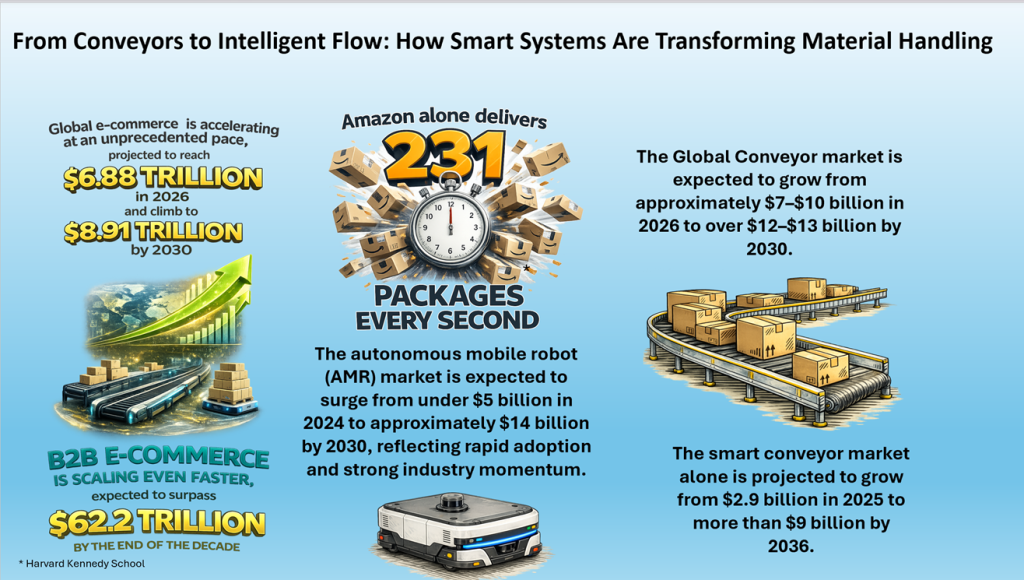
Every second, hundreds of packages are moving, sorted, routed, and delivered with near-perfect precision. According to the Harvard Kennedy School, Amazon alone delivers 231 packages every second. That is 1.6 million packages a day in the U.S. and more than 9 billion items annually. And this is just the beginning.
Global e-commerce is accelerating at an unprecedented pace, projected to reach $6.88 trillion in 2026 and climb to $8.91 trillion by 2030. At the same time, B2B e-commerce is scaling even faster, expected to surpass $62.2 trillion by the end of the decade. Behind every one of these transactions is a physical reality: products must move, quickly, accurately, and efficiently, through factories, distribution centers, and warehouses.
This explosive growth is placing enormous pressure on material handling systems. Traditional conveyors are no longer enough. To keep pace, operations are turning to Autonomous Mobile Robots (AMRs) and smart conveyors, which are powered by HMI/SCADA systems, bringing real-time visibility, intelligent control, and adaptive automation to the backbone of modern logistics.
Because in a world where every second counts, the difference between keeping up and falling behind comes down to how intelligently you move.
From Movement to Intelligence: The Evolution of Conveyor Systems
HMI (Human-Machine Interface) has long been the real-time nerve center of conveyor operations, keeping operators informed, equipment protected, and production running predictably. For decades, it has provided critical visibility into conveyor speed, routing, and system diagnostics across manufacturing and warehousing environments.
But the landscape is changing.
Between 2026 and 2030, the global conveyor market is rapidly shifting from traditional, fixed-speed systems to smart, modular, and data-driven solutions. While the overall market is expected to grow from approximately $7–$10 billion in 2026 to over $12–$13 billion by 2030, the smart conveyor segment is expanding at a significantly faster pace, with a growth rate of around 11% CAGR. In fact, the smart conveyor market alone is projected to grow from $2.9 billion in 2025 to more than $9 billion by 2036.
This shift reflects a fundamental change in operational expectations.
Traditional conveyors were designed to move products from point A to point B efficiently, but are largely static.
Smart conveyors transform that motion into intelligent, adaptive operations. By integrating IoT sensors, AI, and real-time analytics, they continuously optimize routing, adjust speeds, and anticipate maintenance needs, without waiting for human intervention.
The impact is significant:
Intelligence & Connectivity: Smart conveyors communicate in real time, leveraging IoT and AI to track, diagnose, and coordinate across systems, while traditional conveyors rely on fixed logic and manual oversight.
Adaptability: Instead of fixed speeds and paths, smart systems dynamically respond to changing production demands, product variations, and bottlenecks.
Predictive Maintenance: Sensor-driven insights detect wear before failure occurs, reducing downtime and eliminating reactive maintenance.
Operational Visibility: Real-time data delivers full transparency into performance and product flow, far beyond checkpoint-based tracking.
Precision Handling: Advanced motion control enables smoother, more accurate handling, critical for delicate or high-value products.
While traditional conveyors still serve well in straightforward, repetitive applications, today’s operations demand more. Speed, flexibility, and data-driven performance are now essential. In this environment, smart conveyors are powered by modern HMI/SCADA systems. They are taking center stage.
Robots or Conveyors: Choosing the Right Fit for Your Operation
At the same time, autonomous mobile robots (AMRs) are rapidly reshaping material handling.
The market is projected to grow from just under $5 billion in 2024 to $14 billion by 2030, driven largely by logistics and manufacturing applications. Order fulfillment robots alone are expected to account for nearly 50% of shipments by the end of the decade, fueled by continued growth in e-commerce and warehouse automation.
So how do you decide between robots and conveyors?
It starts with understanding your operational priorities.
From a cost perspective, AMRs can be attractive for smaller, flexible deployments. However, as fleets scale, costs can increase quickly. Conveyors may require a higher upfront investment, especially for long distances or high-speed applications, but both solutions typically deliver ROI within 1 to 5 years.
The real distinction comes down to flexibility versus throughput:
AMRs excel in flexibility. They dynamically adjust workflows, transport items to different destinations, collaborate with other robots, and navigate around obstacles, all without fixed infrastructure.
Conveyors excel in throughput. High-speed systems such as shoe sorters, tilt trays, and motorized drive roller (MDR) are engineered to move thousands of items per hour with exceptional consistency and efficiency.
Robotics technology continues to advance, becoming smarter, safer, and more capable, but it can still introduce additional complexity and require specialized training. Conveyors, by contrast, remain a proven and highly reliable backbone for high-volume operations.
In reality, the most effective operations do not choose one over the other; they combine both, using conveyors for speed and volume, and AMRs to introduce flexibility and dynamic movement.
If you would like to learn more about using ADISRA SmartView with AMR robots, check out our blog here.
The Unifying Layer: HMI/SCADA
At the center of both approaches is HMI.
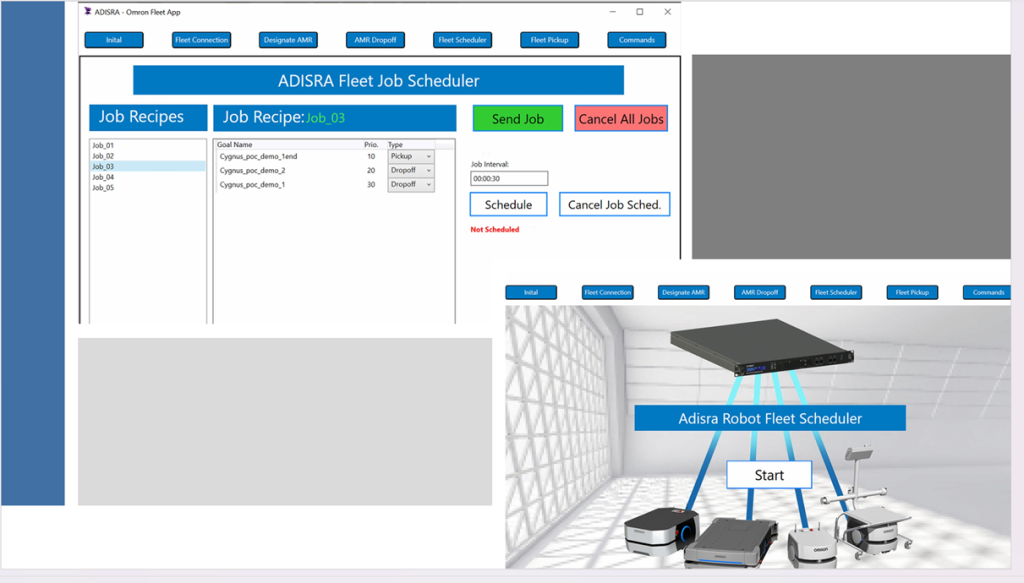
For AMRs, HMI serves as the operator’s interface into the robotic system, accessible through tablets, web dashboards, or mobile devices. It enables real-time monitoring, task assignment, route management, and performance analysis, while improving usability, safety, and operational efficiency.
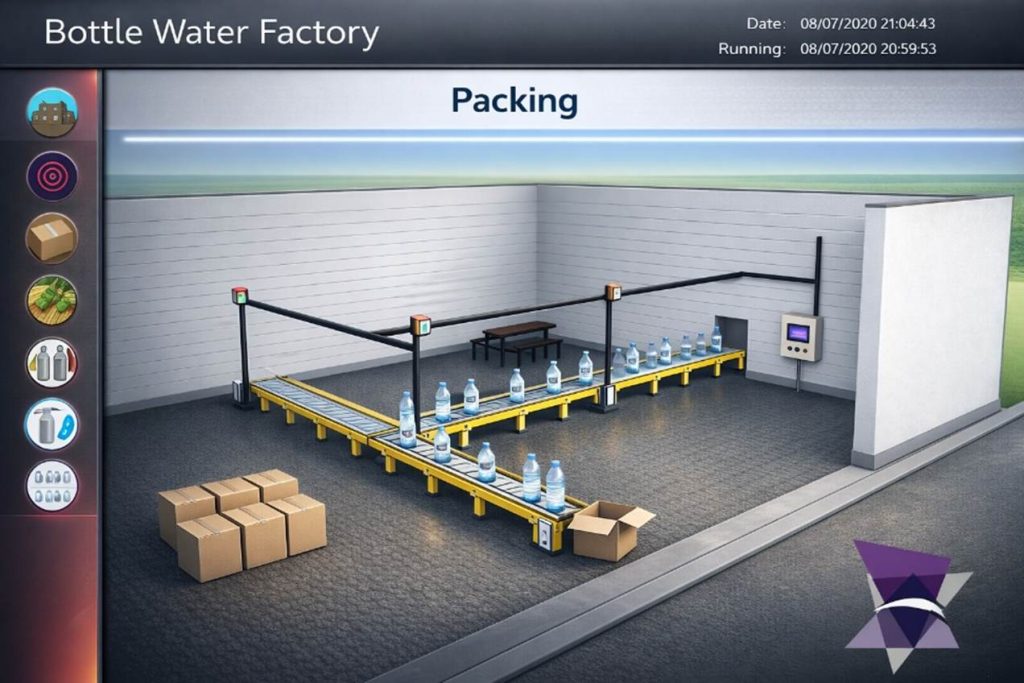
HMIs in smart conveyor systems serve as intuitive, real-time dashboards that connect operators directly to PLCs (Programmable Logic Controllers). Through touchscreen interfaces, they enable continuous monitoring, control, and rapid troubleshooting. By providing real-time insights into package counts, system performance, and motor status, HMIs empower operators to make quick, informed adjustments that improve efficiency and keep operations running smoothly.
As automation continues to evolve, the real advantage lies not in choosing robots or conveyors, but in how intelligently you connect, control, and optimize them.
Whether you are operating fixed conveyor lines, deploying smart conveyors, or scaling AMR fleets, one requirement remains constant:
A unified control and visualization platform.
Bringing It All Together with ADISRA SmartView and InsightView
Modern material handling demands more than automation; it requires coordination, intelligence, and visibility across every system. ADISRA SmartView and InsightView deliver exactly that.
ADISRA SmartView provides a unified HMI/SCADA platform to monitor, control, and optimize your entire operation, from traditional conveyor lines to smart conveyors and autonomous mobile robot (AMR) fleets, all within a single, scalable environment.
What ADISRA SmartView Delivers
– Seamless Connectivity to IIoT and Real-Time Data
Built-in drivers connect directly to sensors such as RFID, barcode scanners, and vision systems, enabling real-time tracking of product position, size, weight, and orientation across the conveyor system.
– Built-In Intelligence for Smarter Decisions
A native rule-based expert system enables predictive maintenance by analyzing data like vibration, motor temperature, and power consumption, helping prevent failures before they occur. It also supports intelligent automation, such as dynamic sorting based on destination, size, or weight.
– Decentralized Intelligence at the Edge
Deployable on Windows or Linux, even in headless environments, ADISRA SmartView enables local processing at conveyor segments. This allows for immediate, autonomous decisions like routing, speed adjustments, and collision avoidance without relying on a central server.
– Seamless Integration Across Systems
Easily integrates with Warehouse Management Systems (WMS), ERP platforms, and other enterprise systems, creating a connected, end-to-end automation ecosystem.
Extending Intelligence with InsightView
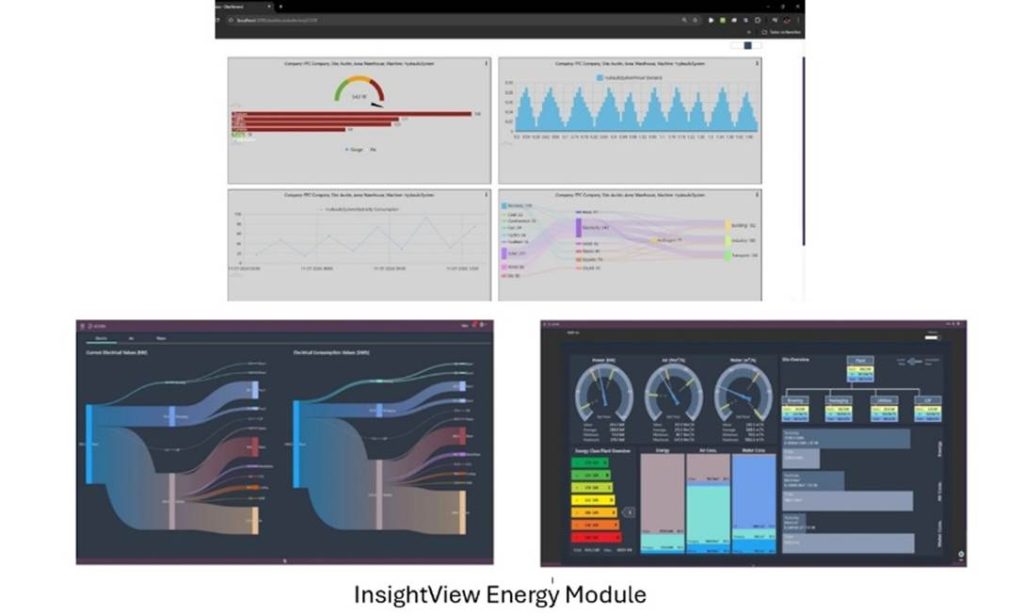
While ADISRA SmartView drives real-time control and local intelligence, InsightView extends that capability with enterprise-level analytics and optimization.
– Energy Management and Sustainability
InsightView includes advanced energy dashboards that optimize machine operation based on real demand. It enables scheduling of energy-intensive processes during off-peak hours, reducing costs and environmental impact while supporting sustainability goals.
– OEE and Productivity Analytics
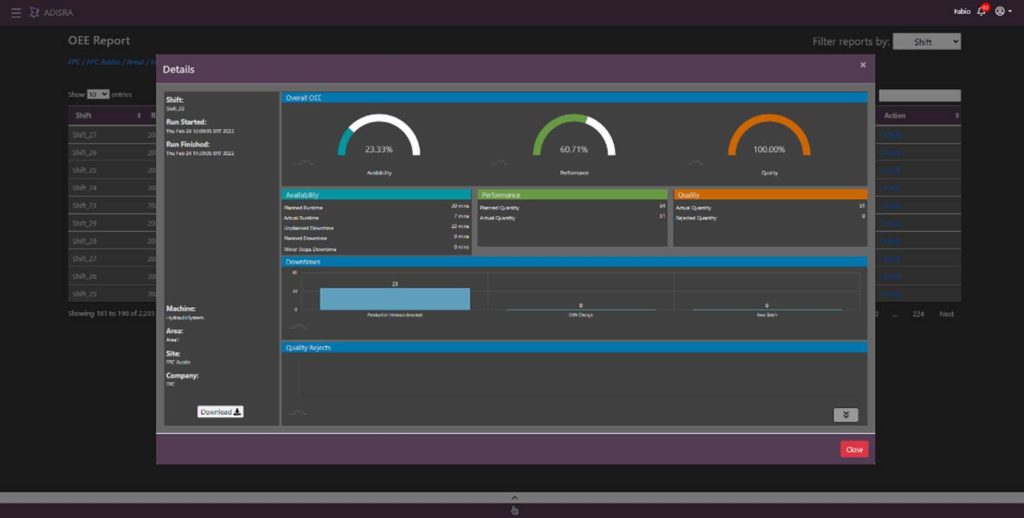
InsightView delivers powerful Overall Equipment Effectiveness (OEE) analytics for smart conveyor systems. By leveraging data collected through ADISRA SmartView and IIoT-connected devices, it provides global visibility into performance, availability, and efficiency, without manual data collection.
– Edge-to-Enterprise Intelligence
ADISRA SmartView handles real-time data collection and local analytics at the edge, while InsightView aggregates that data across machines, lines, and facilities, delivering actionable, enterprise-wide insights.
Driving Efficiency Through Smarter Energy Use
Energy efficiency is no longer optional; it is a competitive advantage.
Smart conveyor systems, powered by ADISRA, optimize energy usage through intelligent controls and on-demand motor activation. This reduces unnecessary power consumption, minimizes component wear, and lowers operating costs, all while maintaining high throughput.
The result is a more sustainable operation with a smaller carbon footprint, without compromising performance.
Conclusion: From Automation to Intelligence
Material handling is no longer just about moving products; it is about moving them intelligently.
As conveyors become smarter and AMRs more prevalent, the real advantage lies in how well these systems are connected, optimized, and controlled. Operations that rely on disconnected tools and reactive processes will struggle to keep up with rising demand, increasing complexity, and the need for real-time decision-making.
The future belongs to operations that are unified, intelligent, and data-driven.
With ADISRA SmartView and InsightView, you gain more than visibility; you gain a platform that brings together conveyors, smart conveyors, and AMRs into a coordinated, adaptive system. From edge-level control to enterprise-wide analytics, ADISRA enables you to improve throughput, reduce downtime, optimize energy usage, and scale with confidence.
Discover how ADISRA SmartView and InsightView can transform your material handling operations into a connected, intelligent system.
Download ADISRA SmartView here, and start building a smarter, more agile operation.
Interested in improving productivity and energy management? Request an InsightView account at info@adisra.com.
If you would like to discuss your specific requirements, you can also request a private consultation and personalized demonstration here.
Join our upcoming webinar, see details below.
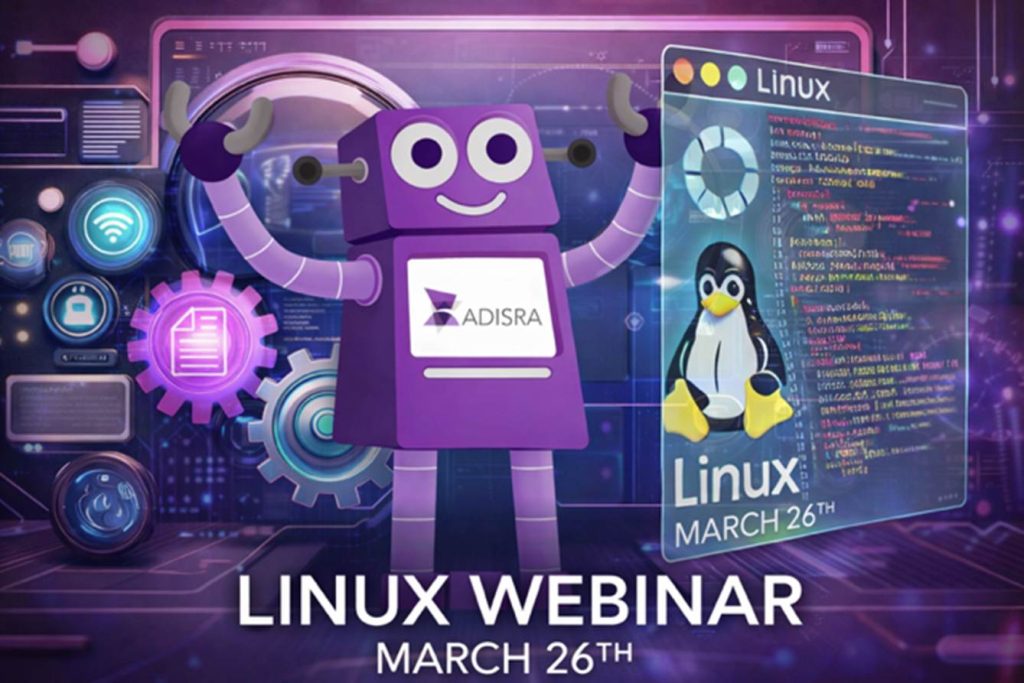
Is Linux part of your automation strategy? Join us to discover how ADISRA SmartView enables industrial applications on the Linux platform. It is the future!
ADISRA SmartView on Linux: Flexible HMI/SCADA for Modern Industrial Systems
In a world increasingly shaped by proprietary ecosystems and large technology platforms, Linux continues to quietly grow as a powerful alternative. While Windows still dominates the desktop market with approximately 73.72% global market share, Linux is rapidly expanding across industrial systems and edge computing.
According to Research and Markets, the Linux operating system market is expected to reach $18.73 billion by 2029. In industrial automation, adoption is already accelerating. SQ Magazine reports that Linux-based PLCs represent 33.1% of newly deployed systems, and 71.9% of edge AI inference workloads run on Linux.
These trends make one thing clear: Linux is becoming a critical platform for modern industrial automation.
Join us for this upcoming webinar where we will demonstrate how to build scalable and robust HMI/SCADA applications using ADISRA SmartView on Linux.
During the session, we will cover:
– Design considerations for Linux deployments.
– Connectivity & Integration – bridging PLCs and databases.
– Security & Maintenance best practices for Linux environments
– Remote Management of your ADISRA SmartView application.
– Edge AI Integration – running an AI expert system using built in rule-based system for predictive maintenance
If Linux is part of your automation strategy, or will be soon, this webinar will show you how ADISRA SmartView enables industrial applications on the Linux platform.
Join us on 26 March 2026, at
7:30 am PDT
9:30 am CDT (Austin, Texas) 10:30 am COT & EDT 2:30 p.m. UTC (Coordinated Universal Time)
3:30 pm CET
4:30 pm EET & SAST
9:30 pm WIB
10:30 pm – SGT
Register for the webinar here.
ADISRA®, ADISRA’S logo, InsightView®, and KnowledgeView® are registered trademarks of ADISRA, LLC.
© 2026 ADISRA, LLC. All Rights Reserved.